Introduction
Enterprise technology is evolving rapidly as organizations embrace cloud computing, automation, containerization, and continuous software delivery. Businesses are expected to release applications faster while maintaining security, reliability, and operational efficiency. Successfully navigating this transformation requires more than adopting new tools—it demands experienced leadership and practical implementation expertise.
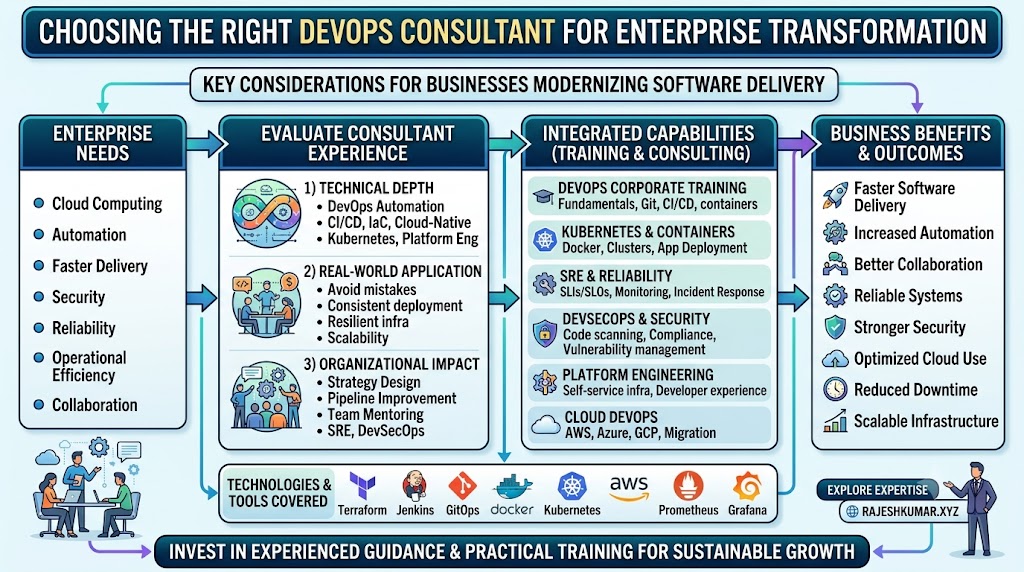
A skilled DevOps Consultant helps organizations modernize software delivery, automate infrastructure, improve collaboration, and build scalable engineering practices. Whether an enterprise is beginning its DevOps journey or optimizing an existing platform, choosing the right consultant can significantly influence the success of digital transformation initiatives.
Professionals and organizations interested in enterprise DevOps consulting, technical mentoring, and corporate training can explore https://www.rajeshkumar.xyz/ to learn more about Rajesh Kumar’s expertise across DevOps, Kubernetes, Site Reliability Engineering (SRE), DevSecOps, Platform Engineering, and Cloud DevOps.
Why Enterprise Transformation Requires a DevOps Consultant
Enterprise transformation involves modernizing technology, improving engineering workflows, and enabling teams to deliver software more efficiently. Without experienced guidance, organizations often encounter inconsistent processes, manual deployments, siloed teams, and infrastructure complexity.
An experienced DevOps Consultant helps organizations:
- Design scalable DevOps strategies
- Improve software delivery pipelines
- Implement CI/CD automation
- Modernize cloud infrastructure
- Increase deployment reliability
- Standardize engineering practices
- Reduce operational bottlenecks
- Improve collaboration between development and operations teams
Rather than focusing solely on technology, a consultant aligns engineering practices with business goals to deliver sustainable improvements.
Characteristics of an Experienced DevOps Consultant
Choosing the right consultant goes beyond technical certifications. Enterprises benefit most from professionals who combine technical depth with real-world implementation experience.
Look for expertise in:
- DevOps automation
- CI/CD pipeline design
- Infrastructure as Code
- Cloud-native architectures
- Kubernetes orchestration
- Platform Engineering
- Site Reliability Engineering
- Security automation
- Cloud migration
- Monitoring and observability
- Release engineering
- Enterprise transformation strategies
An experienced consultant also understands how to mentor teams and guide organizational change.
Why Practical DevOps Experience Matters
Every enterprise has unique infrastructure, compliance requirements, and development workflows. A consultant with production experience understands how to adapt DevOps practices to different environments rather than applying generic solutions.
Practical knowledge helps organizations:
- Avoid common implementation mistakes
- Improve deployment consistency
- Build resilient cloud infrastructure
- Automate repetitive operational tasks
- Scale engineering processes efficiently
- Increase team confidence during transformation
Hands-on expertise is especially valuable when modernizing legacy applications or migrating to cloud-native platforms.
DevOps Trainer and DevOps Corporate Training
Successful transformation depends on skilled people as much as technology. An experienced DevOps Trainer equips engineers, developers, architects, and operations professionals with practical knowledge they can apply immediately.
DevOps Corporate Training typically includes:
- DevOps fundamentals
- Agile collaboration
- Git workflows
- Continuous Integration
- Continuous Delivery
- Infrastructure automation
- Containerization
- Kubernetes
- Cloud platforms
- Monitoring
- Security best practices
For organizations operating in India and globally, a knowledgeable DevOps Trainer in India provides practical learning aligned with enterprise technology challenges.
Kubernetes Expertise for Cloud-Native Enterprises
Containers have transformed application deployment, making Kubernetes a core enterprise technology.
A skilled Kubernetes Trainer helps teams understand:
- Docker fundamentals
- Kubernetes architecture
- Cluster management
- Application deployment
- Autoscaling
- Service discovery
- Storage management
- Networking
- Security
- Production troubleshooting
Organizations also benefit from Kubernetes Corporate Training, ensuring engineering teams adopt standardized deployment practices through comprehensive Docker Kubernetes Training.
SRE Consulting for Reliable Systems
Modern enterprises require reliable, highly available applications. An experienced SRE Consultant helps organizations improve reliability through engineering practices focused on automation and observability.
Key areas include:
- Service Level Indicators (SLIs)
- Service Level Objectives (SLOs)
- Incident response
- Monitoring
- Alerting
- Capacity planning
- Performance optimization
- Error budgets
- Reliability engineering
A practical SRE Trainer also provides Site Reliability Engineering Training that prepares engineering teams to operate large-scale production systems with confidence.
Integrating Security Through DevSecOps
Security should be embedded throughout the software delivery lifecycle rather than added at the end.
A knowledgeable DevSecOps Trainer helps organizations implement:
- Secure CI/CD pipelines
- Code scanning
- Dependency analysis
- Container security
- Compliance automation
- Vulnerability management
- Secret management
- Infrastructure security
DevSecOps Corporate Training ensures development, operations, and security teams work together using consistent security practices.
Platform Engineering for Enterprise Productivity
As organizations grow, engineering teams require standardized platforms that reduce complexity and improve developer productivity.
A Platform Engineering Consultant helps enterprises build internal developer platforms that offer:
- Self-service infrastructure
- Standardized deployment workflows
- Automated provisioning
- Consistent governance
- Shared tooling
- Cloud-native infrastructure
- Improved developer experience
Platform Engineering Training prepares engineering teams to operate and extend these platforms efficiently.
Cloud DevOps Consulting
Cloud adoption is central to enterprise transformation. A Cloud DevOps Consultant helps organizations design secure, scalable, and automated cloud environments.
Typical consulting areas include:
- AWS
- Microsoft Azure
- Google Cloud Platform
- Cloud migration
- Infrastructure as Code
- Cost optimization
- Disaster recovery
- Multi-cloud strategies
- Automation frameworks
An experienced AWS DevOps Consultant assists organizations in implementing reliable AWS-based DevOps solutions that support business growth.
Technologies Commonly Covered
| Area | Tools / Topics | Business Value |
|---|---|---|
| Infrastructure as Code | Terraform Training | Automated infrastructure provisioning |
| Continuous Integration | Jenkins Training | Reliable automated builds |
| Continuous Delivery | CI/CD Pipeline Training | Faster software releases |
| Containers | Docker Kubernetes Training | Cloud-native deployment |
| GitOps | GitOps Training | Consistent application delivery |
| Cloud | AWS DevOps | Scalable cloud infrastructure |
| Monitoring | Prometheus, Grafana | Better observability |
| Security | DevSecOps | Secure delivery pipelines |
| Reliability | SRE | Improved production stability |
| Platform Engineering | Internal Developer Platforms | Higher engineering productivity |
How to Evaluate a DevOps Consultant
When selecting a consultant, enterprises should evaluate:
- Experience with enterprise environments
- Hands-on implementation background
- Cloud platform expertise
- Kubernetes knowledge
- Automation capabilities
- Training and mentoring approach
- Communication skills
- Ability to work with cross-functional teams
- Understanding of security and compliance
- Focus on long-term engineering improvements
Choosing a consultant who emphasizes knowledge transfer ensures internal teams become self-sufficient over time.
Who Benefits Most?
These services are valuable for:
- DevOps Engineers
- Cloud Engineers
- Platform Engineers
- Software Developers
- SRE Teams
- DevSecOps Engineers
- Engineering Managers
- Technical Architects
- Corporate L&D Teams
- Startup Engineering Teams
- Enterprise Technology Leaders
- Organizations planning cloud migration or DevOps transformation
Business Benefits
Organizations working with an experienced DevOps Consultant often achieve:
- Faster software delivery
- Better engineering collaboration
- Increased automation
- Improved deployment quality
- Reduced downtime
- Stronger security practices
- Better cloud utilization
- Improved monitoring
- Greater operational efficiency
- Enhanced developer productivity
- Reliable production systems
- Scalable enterprise infrastructure
Frequently Asked Questions
1. Why should enterprises hire a DevOps Consultant?
A DevOps Consultant helps organizations improve automation, software delivery, infrastructure management, collaboration, and cloud adoption while aligning technology initiatives with business objectives.
2. What does DevOps Corporate Training include?
DevOps Corporate Training covers automation, CI/CD, cloud platforms, Infrastructure as Code, Kubernetes, monitoring, security, and modern software delivery practices through practical learning.
3. Who should attend Kubernetes Corporate Training?
Developers, DevOps engineers, cloud engineers, platform engineers, operations professionals, and technical architects responsible for containerized applications and Kubernetes environments.
4. How does Site Reliability Engineering Training improve production systems?
Site Reliability Engineering Training teaches observability, incident management, monitoring, automation, and reliability practices that reduce downtime and improve service quality.
5. Why is Platform Engineering Training important?
Platform Engineering Training helps organizations create standardized internal platforms that improve developer productivity, simplify infrastructure management, and support scalable cloud-native operations.
Conclusion
Enterprise transformation is a continuous journey that requires experienced guidance, practical engineering knowledge, and effective collaboration across teams. Choosing the right DevOps Consultant enables organizations to modernize infrastructure, automate software delivery, strengthen security, improve reliability, and accelerate cloud adoption.
Whether your organization needs a DevOps Trainer, Kubernetes Trainer, SRE Trainer, DevSecOps Trainer, Platform Engineering Consultant, Cloud DevOps Consultant, or AWS DevOps Consultant, investing in experienced training and consulting helps build sustainable engineering capabilities that support long-term business growth.
To learn more about Rajesh Kumar’s consulting, mentoring, and corporate training services, visit https://www.rajeshkumar.xyz/ and discover how practical DevOps expertise can help your organization achieve successful enterprise transformation.
