Introduction
Organizations today are expected to deliver high-quality software quickly while maintaining security, reliability, and operational efficiency. As digital transformation accelerates across industries, traditional software development and IT operations often struggle to keep pace with growing customer expectations and increasingly complex technology environments. This is where professional DevOps Consulting Services play a critical role.
DevOps is more than a collection of tools—it is a collaborative approach that brings together development, operations, quality assurance, and security teams to streamline software delivery through automation, continuous integration, continuous delivery (CI/CD), and shared responsibility. With the right consulting partner, businesses can modernize their software delivery lifecycle, reduce deployment risks, improve productivity, and create scalable cloud-native platforms.
Cotocus supports organizations in their DevOps transformation journey by providing consulting, implementation, cloud modernization, Kubernetes expertise, infrastructure automation, Site Reliability Engineering (SRE), DevSecOps, platform engineering, GitOps, and enterprise corporate training. Businesses seeking to modernize their technology operations can explore more about these services at https://www.cotocus.com/.
Understanding DevOps Consulting Services
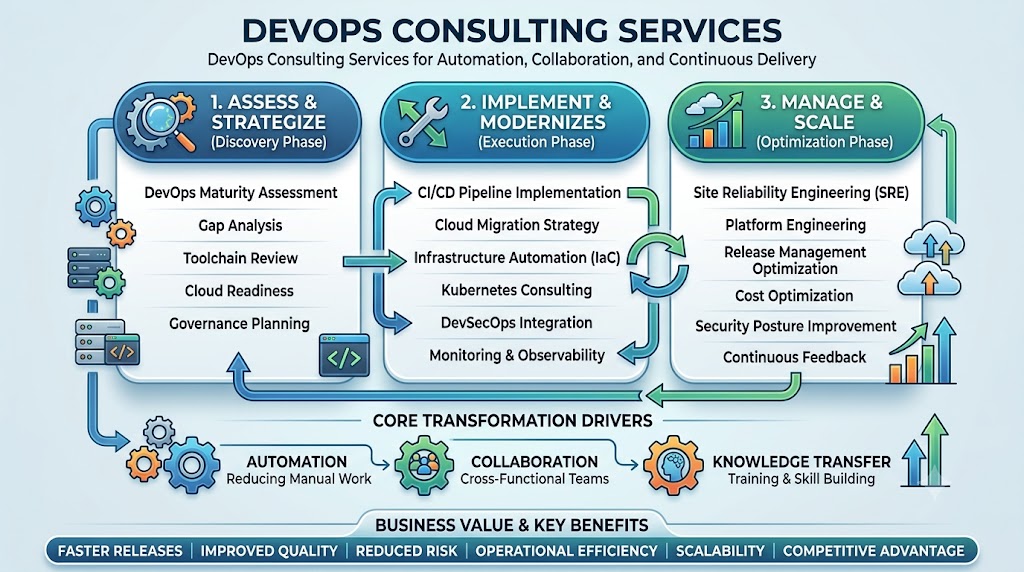
DevOps Consulting Services help organizations improve the way software is developed, tested, deployed, and maintained. Instead of focusing only on technology, consulting engagements also address processes, collaboration, governance, automation, and organizational culture.
A successful DevOps transformation combines modern engineering practices with business objectives to create a faster, more reliable, and more secure software delivery pipeline.
Typical consulting engagements include:
- DevOps maturity assessment
- CI/CD implementation
- Cloud migration strategy
- Infrastructure automation
- Kubernetes consulting
- DevSecOps integration
- Site Reliability Engineering
- Platform engineering
- Monitoring and observability
- Release management optimization
- Enterprise DevOps training
Why Enterprises Need DevOps Consulting
Many organizations continue to rely on manual deployment processes, fragmented development workflows, and isolated operational teams. These challenges often lead to delayed releases, inconsistent environments, higher operational costs, and increased business risk.
Professional consulting helps organizations overcome these obstacles by introducing proven methodologies and automation frameworks.
Common enterprise challenges include:
- Slow release cycles
- Manual software deployments
- Infrastructure inconsistencies
- Limited collaboration between teams
- Cloud migration complexity
- Security integrated too late
- Lack of standardized development practices
- Difficulty scaling applications
- Operational inefficiencies
DevOps consulting provides structured solutions that improve software delivery while supporting long-term business growth.
Automation as the Foundation of DevOps
Automation is one of the most important components of DevOps. Replacing repetitive manual activities with automated workflows reduces errors, improves consistency, and enables engineering teams to focus on innovation.
Automation can be applied to:
Infrastructure Provisioning
Infrastructure as Code (IaC) enables environments to be provisioned consistently using version-controlled templates.
Continuous Integration
Developers can integrate code changes frequently while automated testing validates application quality.
Continuous Delivery
Applications move through testing and deployment pipelines automatically, reducing release delays.
Monitoring
Automated monitoring and alerting provide real-time visibility into application health and infrastructure performance.
Compliance
Security checks and compliance validations become part of automated deployment pipelines.
Building Better Collaboration Across Teams
Traditional IT environments often separate development, operations, testing, and security into independent teams. This creates communication gaps, duplicated work, and deployment delays.
DevOps promotes collaboration by encouraging shared ownership of software delivery.
Benefits include:
- Faster issue resolution
- Improved communication
- Shared operational visibility
- Better planning
- Reduced deployment conflicts
- Continuous feedback between teams
Collaborative engineering practices create more efficient software delivery processes while improving overall product quality.
Continuous Integration and Continuous Delivery
Continuous Integration (CI) and Continuous Delivery (CD) form the backbone of modern DevOps practices.
Continuous Integration
Developers integrate code into shared repositories regularly. Automated testing validates every change before it progresses through the pipeline.
Advantages include:
- Early bug detection
- Higher code quality
- Faster development cycles
- Reduced integration issues
Continuous Delivery
Continuous Delivery automates software deployment through development, testing, staging, and production environments.
Organizations benefit from:
- Faster releases
- Reduced deployment failures
- Improved software quality
- Predictable release schedules
CI/CD enables businesses to deliver customer value continuously rather than waiting for large release cycles.
Cloud-Native DevOps Transformation
Cloud platforms have transformed enterprise IT by providing scalability, flexibility, and on-demand infrastructure.
DevOps consulting helps organizations maximize cloud investments through:
- Cloud readiness assessments
- Migration planning
- Multi-cloud strategies
- Infrastructure automation
- Cloud governance
- Security best practices
- Cost optimization
- High availability architecture
Cloud-native environments become more effective when combined with automated DevOps workflows.
Kubernetes Consulting for Modern Applications
Containerized applications require efficient orchestration platforms.
Kubernetes provides automation for:
- Container deployment
- Scaling
- Service discovery
- Load balancing
- Resource management
- High availability
DevOps consultants assist organizations with:
- Kubernetes architecture
- Cluster deployment
- Container migration
- Security hardening
- Monitoring integration
- Operational best practices
Corporate Kubernetes training further enables internal teams to manage container platforms confidently.
DevSecOps for Secure Delivery
Security cannot be treated as a separate phase in modern software development.
DevSecOps integrates security into every stage of the development lifecycle.
Key consulting areas include:
- Secure CI/CD pipelines
- Automated security testing
- Container security
- Vulnerability management
- Secrets management
- Compliance automation
- Policy enforcement
- Secure infrastructure
This proactive approach improves software security without slowing development.
Site Reliability Engineering
Reliable digital services require proactive operational management.
Site Reliability Engineering focuses on:
- Service Level Indicators (SLIs)
- Service Level Objectives (SLOs)
- Incident management
- Monitoring
- Capacity planning
- Automation
- Production stability
- Reliability improvement
SRE practices help organizations maintain consistent application performance while reducing operational risk.
Platform Engineering for Developer Productivity
Platform engineering creates reusable internal platforms that simplify software development.
Benefits include:
- Standardized environments
- Faster onboarding
- Self-service infrastructure
- Improved governance
- Better developer experience
- Reduced operational complexity
Well-designed developer platforms allow engineering teams to deliver software more efficiently.
Infrastructure Automation
Managing infrastructure manually becomes increasingly difficult as environments grow.
Infrastructure automation enables organizations to:
- Provision environments automatically
- Maintain consistency
- Improve scalability
- Reduce manual errors
- Accelerate deployments
- Support disaster recovery
Infrastructure as Code also improves governance through version-controlled configuration management.
Enterprise DevOps Corporate Training
Technology transformation succeeds when people develop the necessary skills alongside new processes and tools.
Corporate training programs typically include:
- DevOps fundamentals
- CI/CD
- Docker
- Kubernetes
- Cloud platforms
- Infrastructure as Code
- DevSecOps
- GitOps
- Monitoring
- SRE practices
Practical learning helps engineering teams apply DevOps principles effectively within enterprise environments.
Business Benefits of DevOps Consulting Services
Organizations adopting DevOps consulting often experience measurable improvements across software delivery and operations.
| Traditional IT Operations | DevOps-Driven Operations |
|---|---|
| Manual deployments | Automated deployment pipelines |
| Separate engineering teams | Collaborative cross-functional teams |
| Long release cycles | Continuous delivery |
| Manual infrastructure | Infrastructure as Code |
| Reactive operations | Proactive monitoring |
| Security at final stages | Integrated DevSecOps |
| Slow provisioning | Automated infrastructure |
| Limited scalability | Cloud-native scalability |
| Higher operational costs | Greater operational efficiency |
Why Enterprises Partner with Cotocus
Successful DevOps transformation requires practical experience, modern engineering knowledge, and a structured implementation approach.
Cotocus supports organizations with consulting services that span DevOps, cloud migration, Kubernetes, infrastructure automation, Site Reliability Engineering, DevSecOps, GitOps, platform engineering, CI/CD optimization, and enterprise corporate training. By combining consulting with knowledge transfer, organizations can build long-term internal capabilities while accelerating digital transformation initiatives.
Frequently Asked Questions
What are DevOps Consulting Services?
DevOps Consulting Services help organizations modernize software development and IT operations through automation, collaboration, cloud adoption, and continuous delivery practices.
How does DevOps improve software delivery?
DevOps reduces manual work, automates deployments, strengthens collaboration, and enables faster, more reliable software releases.
Why is automation important in DevOps?
Automation improves consistency, reduces human error, accelerates deployments, and frees engineering teams to focus on innovation.
What is CI/CD?
Continuous Integration and Continuous Delivery automate software testing and deployment, enabling faster and safer releases.
How does Kubernetes support DevOps?
Kubernetes automates container orchestration, improves scalability, enhances reliability, and simplifies application management.
What is DevSecOps?
DevSecOps integrates security into every stage of software development, ensuring secure and compliant application delivery.
How does SRE improve reliability?
Site Reliability Engineering uses automation, monitoring, SLIs, SLOs, and incident management to improve production stability.
Why is Infrastructure as Code valuable?
Infrastructure as Code enables consistent, repeatable, and automated infrastructure provisioning using version-controlled templates.
Who benefits from DevOps Corporate Training?
Development teams, operations engineers, cloud architects, platform teams, security professionals, and engineering leaders all benefit from practical DevOps training.
Why choose Cotocus for DevOps Consulting?
Cotocus combines consulting expertise, cloud modernization, automation, enterprise training, Kubernetes, DevSecOps, Site Reliability Engineering, and platform engineering to help organizations accelerate software delivery and achieve sustainable digital transformation.
Conclusion
Professional DevOps Consulting Services help enterprises improve automation, strengthen collaboration, and implement continuous delivery practices that accelerate software development while maintaining security, reliability, and operational excellence. By adopting cloud-native technologies, infrastructure automation, CI/CD pipelines, Kubernetes, DevSecOps, and Site Reliability Engineering, organizations can build modern technology platforms capable of supporting future business growth.
Cotocus partners with enterprises to guide these transformation initiatives through consulting, implementation support, and enterprise training. Organizations seeking to modernize software delivery, automate infrastructure, improve cloud operations, and build high-performing engineering teams can learn more by visiting https://www.cotocus.com/.
