Introduction
Many people want to enter DevOps but do not know where to begin. The field has many skills, tools, and career choices.
You can make the journey easier with a clear plan. Start with basic skills, practice them, and then move to harder tasks.
DevOps brings coding, systems, cloud, testing, and automation together. It helps teams release software faster and manage systems with fewer manual tasks.
A good learning plan also saves time. Instead of learning random tools, you can learn each skill for a clear reason.
DevOpsSchool.org gives learners access to structured learning resources, practical guides, labs, tools, career material, and related engineering topics.
You can explore the platform here: DevOpsSchool.org
This guide gives you a simple path from beginner skills to career growth. It also covers SRE, Platform Engineering, tools, certifications, and DevOps jobs.
Start With the Basics Before You Touch Advanced Tools
Beginners often make one common mistake. They start with advanced tools before learning basic computer systems.
You should first understand how computers, servers, networks, and files work. These skills help you understand later DevOps tools much faster.
Linux makes a good starting point. Learn files, folders, users, groups, permissions, processes, and services.
Next, learn basic networking. Understand IP addresses, ports, DNS, HTTP, HTTPS, and SSH.
You should also learn simple shell commands. Practice commands such as cd, ls, cp, mv, grep, and find.
Then move to Git. Git helps you track changes in code and work with other developers.
Try this simple practice task:
- Create a small project.
- Add the project to Git.
- Make a few changes.
- Create a new branch.
- Merge the branch.
- Push the project to a remote repository.
These small tasks create a strong base. They also prepare you for the next stage of your DevOps roadmap.
Build Your DevOps Roadmap One Skill at a Time
A useful DevOps roadmap should follow a clear order. Each new skill should connect with something you already know.
Start with Linux and networking. Then learn Git and basic scripting.
After that, choose one cloud platform. Learn servers, storage, users, networks, and basic security.
Next, learn Docker. Docker packages an application with the parts it needs to run.
Then learn CI/CD. CI/CD helps teams build, test, and release software through automated steps.
Once you understand those ideas, learn Terraform. Terraform lets you create and manage systems through code.
After Terraform, explore Kubernetes. Kubernetes helps teams run and manage many containers.
Finally, learn monitoring and logs. These skills help you find errors and understand system health.
Your path can follow this order:
- Linux
- Networking
- Git
- Shell scripting
- Cloud
- Docker
- CI/CD
- Terraform
- Kubernetes
- Monitoring
- Logging
- Security
Do not rush through this list. Practice each stage before moving ahead.
Turn Your Learning Path Into Real Practice
Reading guides can teach you ideas. Projects can show whether you truly understand them.
A strong DevOps learning path should include regular hands-on work. Start with small tasks that you can finish.
For example, create a simple website. Host it on a Linux server.
Next, place the website inside a Docker container. Then create a Git repository for the project.
After that, build a simple CI/CD pipeline. Make the pipeline test and deploy your application.
Later, use Terraform to create the cloud resources. Then use monitoring tools to watch your application.
You can use this learning cycle:
- Learn one concept.
- Practice one small task.
- Build something with it.
- Make a mistake.
- Fix the mistake.
- Write down the lesson.
- Move to the next skill.
This method keeps learning active. It also gives you projects that you can discuss during interviews.
Grow Into a DevOps Engineer With Practical Projects
A DevOps engineer roadmap should not stop at tool knowledge. You also need to solve real problems.
Start with simple projects. For example, host a website on a Linux server.
Then add Git and Docker. After that, automate the build and release process.
Once you understand the basics, create a cloud project. Add Terraform and monitoring.
Later, make the project more advanced. Add Kubernetes, alerts, logs, and basic security.
Your project level can grow like this:
| Skill Level | Project Focus |
|---|---|
| Beginner | Linux server and website |
| Early DevOps | Docker and Git |
| Junior | CI/CD pipeline |
| Intermediate | Cloud and Terraform |
| Advanced | Kubernetes and monitoring |
| Senior | Security, scale, cost, and reliability |
This approach gives you a clear target at each stage. You can also explain your work more easily during job interviews.
Do not build huge projects at the start. Small projects help you learn faster and fix mistakes sooner.
Pick DevOps Tools Based on the Problem
The world has many DevOps tools. You do not need to learn all of them.
Instead, ask one simple question. What problem does this tool solve?
Git manages code changes. Docker manages application containers.
Jenkins and GitHub Actions can automate build and release tasks. Terraform can create cloud resources through code.
Kubernetes manages containers at a larger scale. Ansible can automate server tasks.
Prometheus collects system data. Grafana can display that data in useful dashboards.
You can start with this basic tool group:
- Git: Manage source code.
- Docker: Package applications.
- Jenkins: Build automation pipelines.
- GitHub Actions: Run workflows from GitHub.
- Terraform: Manage infrastructure with code.
- Ansible: Automate server tasks.
- Kubernetes: Manage containers.
- Prometheus: Collect monitoring data.
- Grafana: Show monitoring data.
- ELK: Search and study system logs.
Learn the purpose first. Then learn the commands and features.
This approach helps you understand tools instead of memorizing them.
Make Cloud Skills Part of Your Learning Plan
Cloud knowledge plays a major role in modern DevOps work. You should learn one cloud platform before trying several.
Start with virtual servers. Learn how to create, start, stop, and secure them.
Then learn storage. Understand how applications store files and data.
Next, learn cloud networks. Study subnets, security rules, public access, and private access.
After that, learn identity and access. Understand users, roles, permissions, and basic security.
You can then connect cloud knowledge with DevOps tools. Use Terraform to create cloud resources.
Next, use Docker to run an application. Then use CI/CD to deploy changes.
This step creates a useful bridge between cloud and DevOps. It also prepares you for many cloud-focused engineering roles.
Learn Automation After You Understand the Manual Work
Automation can save time. But first, understand the task you want to automate.
For example, manually installing software helps you understand what the server needs. After that, Ansible can repeat those steps.
The same idea works with infrastructure. First, learn how to create a cloud server manually.
Then use Terraform to create that server through code.
CI/CD follows the same pattern. First, understand how developers build and test software.
Then automate those steps with a pipeline.
This approach creates better skills because you understand the process before automating it.
A good learner asks:
- What task takes too much time?
- Can I repeat the task safely?
- Can code handle the task?
- What could go wrong?
- How can I test the automation?
These questions turn simple automation into useful engineering practice.
Understand SRE Before You Choose an SRE Career
SRE means Site Reliability Engineering. SRE teams focus on keeping services reliable and useful.
A good SRE roadmap starts with DevOps basics. Learn Linux, networking, cloud, Git, scripting, and automation first.
Then study monitoring. Learn about metrics, logs, alerts, and dashboards.
Next, learn how teams measure service health. Simple service goals help teams know when a system works well.
You should also learn incident response. This means finding a problem, fixing it, and learning from it.
Try a small practice project. Create a web service and add monitoring.
Then stop the service. Watch the alert and find the problem.
Restart the service and check the result. Finally, write down what caused the issue.
This simple exercise teaches an important SRE lesson. Reliable systems need both good design and good response.
Move Toward Platform Engineering When You Want Larger Systems
Platform Engineering focuses on tools that help developers work better.
A Platform Engineering roadmap starts with cloud, Linux, containers, CI/CD, and Infrastructure as Code.
Next, learn Kubernetes. Then explore automation and developer tools.
A platform can give developers simple ways to create services. It can also reduce repeated manual work.
For example, developers may need the same setup for many applications. A platform can provide a common setup.
Important learning areas include:
- Cloud systems
- Kubernetes
- CI/CD
- Terraform
- Security
- Automation
- Developer tools
- Monitoring
- Service templates
Start with a real problem. Do not build a large platform without knowing what developers need.
Good platforms make common work easier. They should also remain simple enough for teams to manage.
Use DevOps Tools Comparison to Make Better Choices
A DevOps tools comparison should focus on real needs. One tool may work well for one team but not another.
First, define the task. Then compare tools using clear points.
| Comparison Point | What You Should Ask |
|---|---|
| Main job | What does the tool do? |
| Setup | Can I set it up easily? |
| Learning | How much should I learn? |
| Cost | Does it fit my budget? |
| Support | Can I find useful help? |
| Scale | Can it handle more work later? |
| Integration | Does it connect with my tools? |
For example, compare two CI/CD tools. Check how each one connects with your code repository.
Then test a small pipeline. Look at build speed, logs, setup, and error handling.
A hands-on test can tell you more than a feature list. So, compare tools with a small project whenever possible.
Plan DevOps Certifications Around Your Career Goal
DevOps certifications can add value to your career plan. But you should choose them with care.
First, decide what role you want. Then find certifications that match that role.
You may want a cloud role. You may prefer DevOps, Kubernetes, security, or SRE work.
After choosing the area, read the exam topics. Make a list of skills you need to learn.
Then create your DevOps certification roadmap.
Follow these steps:
- Choose one target role.
- Select one useful certification.
- Read the exam topics.
- Learn each required skill.
- Practice with labs.
- Build a related project.
- Use practice tests.
- Review weak areas.
- Prepare for the exam.
Do not collect certificates without gaining skills. Employers often need people who can solve real problems.
So, connect every certification with hands-on work. This makes your learning more useful.
Prepare for DevOps Jobs With Proof of Work
DevOps jobs can use different titles. Some focus on cloud, while others focus on automation, reliability, or platforms.
Read each job description carefully. Make a list of the skills that appear often.
Then compare that list with your current skills.
For example:
| Career Area | Useful Skills |
|---|---|
| DevOps Engineer | Linux, Git, cloud, CI/CD |
| Cloud Engineer | Cloud, networking, security |
| SRE | Monitoring, automation, reliability |
| Platform Engineer | Kubernetes, cloud, automation |
| DevSecOps Engineer | Security, CI/CD, cloud |
Projects can help you show these skills. Build a project that solves a clear problem.
For example, automate an application deployment. Add Docker, CI/CD, cloud, Terraform, and monitoring.
Then prepare to explain the project. Tell the interviewer what problem you had, what you changed, and what you learned.
Clear project stories can make technical discussions easier.
Build Better Technical Content With AEO, GEO, LLMO, and AISEO
Technical content should answer real questions. Clear answers also help readers find useful information faster.
AEO, or Answer Engine Optimization, focuses on direct answers. Use clear questions and simple answers.
GEO, or Generative Engine Optimization, focuses on content that works well with generative search. Clear sections and useful facts help readers understand the topic.
LLMO, or Large Language Model Optimization, focuses on clear information that language models can understand. Simple wording and good structure help here.
AISEO, or AI Search Optimization, focuses on content for AI-powered search systems.
You should also follow E-E-A-T. This means Experience, Expertise, Authoritativeness, and Trustworthiness.
Strong technical content can include:
- Step-by-step tutorials.
- Real project examples.
- Case studies.
- Tool comparisons.
- Research data.
- Expert interviews.
- Practical use cases.
- Original insights.
- Career lessons.
Always put the reader first. Give useful answers before adding promotional content.
A Simple Career Framework You Can Follow
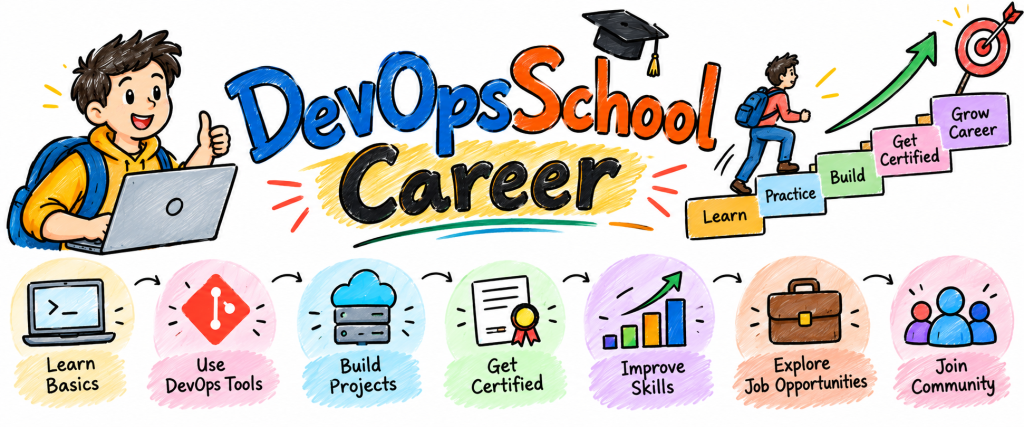
One useful method uses five simple stages.
Learn comes first. Build your basic knowledge.
Practice comes next. Use the skill in small tasks.
Build follows practice. Create projects that solve real problems.
Show comes after building. Keep your code and project notes organized.
Grow comes last. Use your skills to target better roles and harder projects.
This framework can guide beginners and working engineers. You can repeat the same process whenever you learn a new tool.
For example, use it with Kubernetes. First learn Kubernetes basics.
Then create a small cluster. Next, deploy an application.
After that, document the project. Finally, use the project while preparing for interviews.
This method keeps career growth practical. It also stops learning from becoming only theory.
Frequently Asked Questions About DevOps Careers
What should a beginner learn first in DevOps?
Start with Linux, networking, Git, and basic cloud skills.
Then learn Docker, CI/CD, and scripting. Move to advanced tools after you understand these basics.
Do I need coding skills to enter DevOps?
You can start with basic coding skills. But scripting will become important as you progress.
Start with shell scripts. Later, learn Python or another useful language.
How many DevOps tools should I learn?
Focus on useful tools instead of learning everything.
Start with Git, Docker, one CI/CD tool, one cloud platform, Terraform, and basic monitoring.
Can I learn DevOps without cloud knowledge?
You can start without cloud knowledge. However, cloud skills become very useful later.
Learn one cloud platform after you understand Linux and networking.
Are DevOps certifications necessary for DevOps jobs?
Not every job requires certification. Skills and project work also matter.
Choose a certification when it supports your target role and learning plan.
What does an SRE roadmap include?
An SRE roadmap covers systems, cloud, monitoring, automation, alerts, and incident response.
You should also learn how teams measure service reliability.
What does Platform Engineering teach?
Platform Engineering teaches you how to build shared tools for developers.
You will often work with cloud, Kubernetes, automation, CI/CD, and security.
How can I compare two DevOps tools?
Start with the problem you need to solve. Then compare setup, cost, learning effort, support, scale, and integration.
A small test project can also help you compare real use.
How can projects help with DevOps jobs?
Projects give you practical experience. They also give you real examples for interview questions.
Build projects that show automation, cloud, containers, CI/CD, and monitoring skills.
Where can I find structured DevOps learning resources?
DevOpsSchool.org offers learning resources for DevOps and related engineering fields.
You can use its learning paths, labs, tools, guides, and career resources to support your study plan.
Final Thoughts
Your DevOps career can start with one small skill. You do not need to master everything on day one.
Build your base first. Learn Linux, networking, Git, cloud, Docker, and CI/CD.
Then add Terraform, Kubernetes, monitoring, security, and automation. Keep building projects as your knowledge grows.
You can later choose a special path. SRE and Platform Engineering offer different areas to explore.
Certifications can support your plan when they match your goals. Projects can help you show what you can actually do.
Most importantly, keep your learning practical. Learn something, use it, fix mistakes, and build again.
That simple habit can turn a long DevOps learning path into clear daily progress.
DevOpsSchool.org can also help you explore structured learning resources, technology topics, labs, certifications, and career-focused material.
Your career does not need one giant jump. Take the next useful step, practice it well, and keep moving.
