Introduction
The stock market often feels complicated for beginners. Terms like investing, trading, charts, IPOs, and analysis can create confusion and hesitation.
Many new learners try to start investing without understanding the basics, which leads to emotional decisions and unnecessary losses. This happens mainly due to lack of proper stock market education and structured learning.
To succeed in the stock market, you don’t need advanced financial knowledge at the beginning. What you need is a simple, step-by-step approach to learning how markets actually work.
This guide from StocksMantra.com explains stock market basics in a simple and practical way so beginners can build confidence before investing or trading.
What Is the Stock Market in Simple Words?
The stock market is a place where people buy and sell shares of companies.
- Companies raise money by issuing shares
- Investors buy shares to become part-owners
- Prices move based on demand, supply, and company performance
In simple terms, the stock market connects businesses and investors for wealth creation and capital growth.
Why Beginners Find the Stock Market Confusing
Most beginners struggle because:
- Too many new terms at once
- Lack of clear learning structure
- Following tips instead of understanding concepts
- Emotional decision-making
- No proper guidance or roadmap
Without a structured approach, learning becomes random and overwhelming.
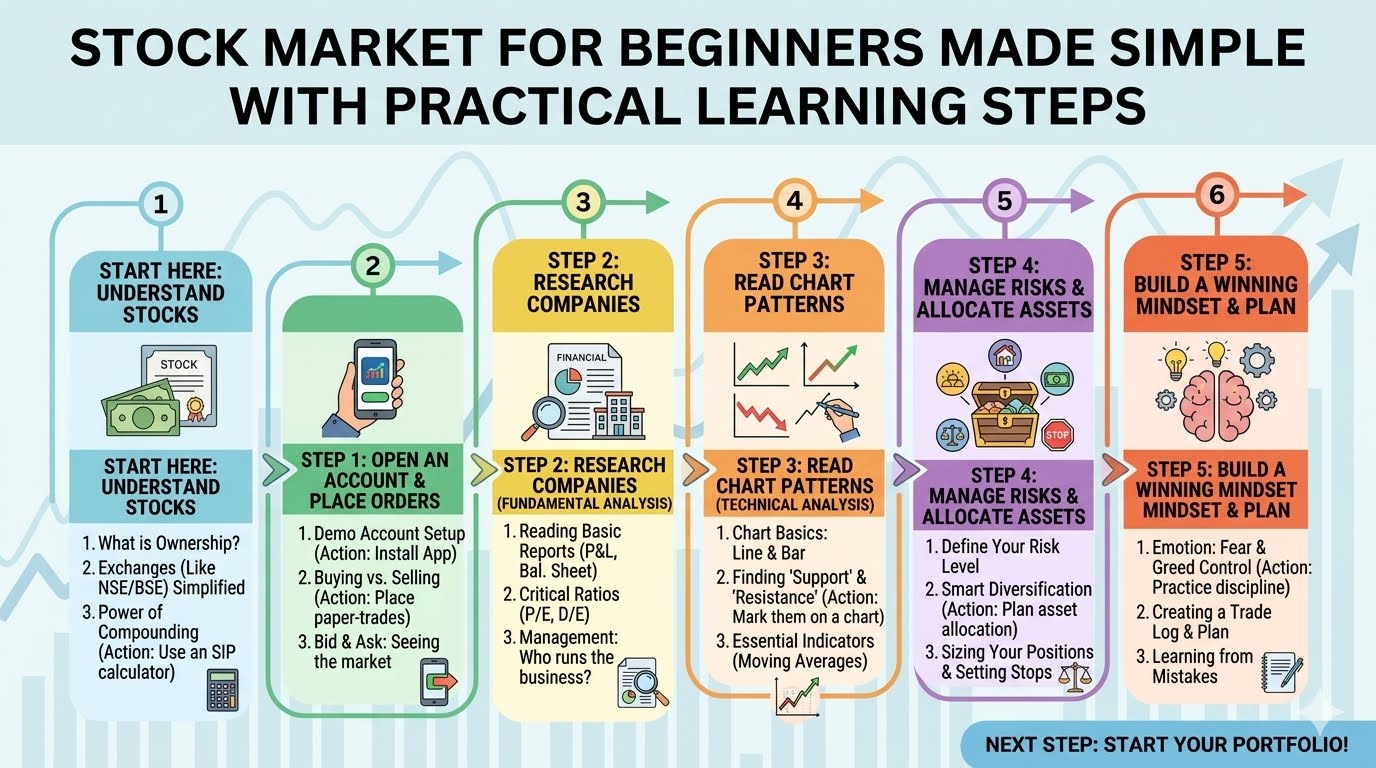
Stock Market for Beginners: Step-by-Step Learning Approach
Here is a simple and practical learning path:
Step 1: Understand Basic Stock Market Terms
Start with simple concepts:
- Stock
- Share
- Exchange (NSE, BSE)
- Demat account
- Trading account
- Broker
These are the building blocks of the stock market.
Step 2: Learn How the Stock Market Works
Understand:
- How companies list shares through IPOs
- How buyers and sellers trade stocks
- How prices move based on demand and supply
- How news and earnings affect stock prices
Step 3: Learn the Difference Between Investing and Trading
| Feature | Investing | Trading |
|---|---|---|
| Time Period | Long-term | Short-term |
| Goal | Wealth creation | Quick profit |
| Risk | Lower | Higher |
| Focus | Business growth | Price movement |
| Analysis | Fundamental | Technical |
Beginners should focus on investing first to build stability.
Step 4: Learn About Risk in the Market
Risk is the possibility of losing money.
Important points:
- Every investment has risk
- Higher returns usually come with higher risk
- Market prices fluctuate daily
- Risk management is essential for survival
Step 5: Start Understanding Companies
Before investing, learn:
- What the company does
- How it earns money
- Its competitors
- Its growth history
- Its industry position
You are not just buying a stock—you are buying a business.
Step 6: Learn Basic Financial Statements
Understand simple parts:
- Revenue (total income)
- Profit (money left after expenses)
- Debt (borrowed money)
- Expenses
- Growth trends
This helps in evaluating company strength.
Step 7: Learn Fundamental Analysis
Fundamental analysis helps you understand if a company is strong or weak.
It includes:
- Business model
- Financial performance
- Management quality
- Industry position
- Future growth potential
Step 8: Learn Basic Technical Analysis
Technical analysis helps understand price movement.
Key concepts:
- Charts
- Trends (up, down, sideways)
- Support and resistance
- Volume
- Candlestick patterns
This is more useful for traders.
Step 9: Learn About IPOs
An IPO is when a company sells shares to the public for the first time.
Before investing, check:
- Business model
- Financial stability
- Growth potential
- Valuation
- Risks mentioned in documents
Avoid investing only based on hype.
Step 10: Build Discipline and Patience
Successful investing depends on:
- Long-term thinking
- Emotional control
- Consistent learning
- Avoiding unnecessary trading
- Staying patient during volatility
Common Mistakes Beginners Should Avoid
- Investing without understanding
- Following tips blindly
- Overtrading
- Ignoring risk
- Expecting fast profits
- Panic selling during drops
- Investing borrowed money
Stock Market Learning Roadmap Summary
- Learn basic terms
- Understand how markets work
- Study investing vs trading
- Learn risk management
- Study companies
- Understand financial statements
- Learn fundamental analysis
- Learn technical basics
- Study IPOs
- Build discipline
How StocksMantra.com Helps Beginners
StocksMantra.com helps simplify stock market learning by providing:
- Beginner-friendly stock market education
- Investing and trading basics
- IPO learning guidance
- Market research concepts
- Financial awareness content
- Easy explanations of complex topics
The goal is to help learners build knowledge before investing in real markets.
Best Practices for Beginners
- Start small and learn step by step
- Focus on long-term investing
- Always research before investing
- Avoid emotional decisions
- Diversify investments
- Keep learning regularly
Expert Tips
- Focus on understanding businesses, not just stock prices
- Patience is more important than prediction
- Risk management matters more than returns
- Avoid market noise and rumors
- Consistency builds long-term success
FAQs
1. What is the stock market in simple words?
It is a place where shares of companies are bought and sold.
2. How can beginners learn the stock market?
By starting with basic terms and gradually learning investing and analysis.
3. What is investing vs trading?
Investing is long-term, trading is short-term buying and selling.
4. What is fundamental analysis?
It is studying a company’s financial health and business strength.
5. What is technical analysis?
It is studying charts and price patterns to understand market movement.
6. Is the stock market risky for beginners?
Yes, but education and discipline reduce risk significantly.
7. What is an IPO?
It is when a company sells shares to the public for the first time.
8. How should beginners start investing?
Start small, learn basics, and focus on long-term goals.
9. What are common beginner mistakes?
Following tips blindly, emotional investing, and lack of research.
10. Why is stock market education important?
It helps avoid losses and builds strong investing habits.
Conclusion
Stock market success does not come from guessing or luck. It comes from understanding, discipline, and continuous learning.
A structured approach to stock market for beginners helps you build confidence and make informed decisions instead of emotional ones.
If you are starting your journey, focus first on learning the basics before investing real money.
To continue your learning, explore beginner-friendly resources on StocksMantra.com and build your foundation in investing, trading, IPOs, and market research.
